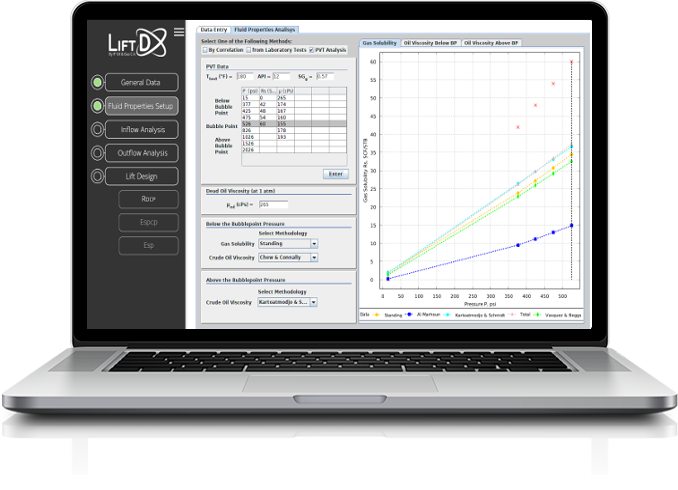
LIFTD is a computational application developed for diagnosis and optimization of oil producing wells. This app has three modules: Fluid Properties Setup; Inflow Analysis; Outflow Analysis. Considering that some artificial lift systems are very sensitive to viscosity, the fluid properties setup module was specially structured to what a designer can consider and carefully analyze this variable. In the inflow analysis module, it was considered to use simple methods to calculate the inflow performance relationship IPR curve. The outflow analysis module includes four methodologies: Duns and Ros; Hagedorn and Brown; homogeneous model; Fancher and Brown. Additional characteristics of this app are the possibility to estimate the natural separation efficiency (necessary to predict the percentage of free gas at any depth of interest), and the flow pattern. On the other hand, this app has a design module which can be used to design any type of artificial lift systems such as: ESPCP; ESP; Continuous Gas Lift; Hydraulic Pumps; etc.
Designed By: Eng. Richard Marquez Guillen, Ph.D Co-Designed By: Eng. Jairo Garcia Developer: Rafael Cayama, Jesus Oroño, Zeudy Galban, Robert Quintero
HPS-D
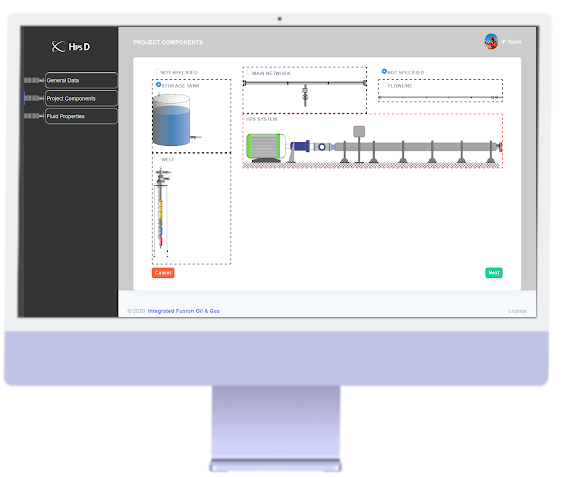
A Horizontal Pumping System HPS unit typically consists of a horizontal multi-stage centrifugal pump, prime mover, thrust chamber, intake manifold, and discharge, all mounted on a skid. It is generally used to transfer large quantities of fluids in the oil industry. Due to the large number of centrifugal pump manufacturers, HPSD represents a very good option in the design, diagnosis, and optimization of this type of system due to this computational application allows to select the pump performance curves from different manufactures, based on the required operational conditions, including the viscosity effect on the head, horsepower, and efficiency of the pump. This computational application has a database of each of the main components of the system, which allows rapid system design, reducing time and increasing profits.
Designed By: Eng. Richard Marquez Guillen, Ph.D Co-Designed By: Eng. Jairo Garcia Developer: Rafael Cayama, Jesus Oroño, Zeudy Galban, Robert Quintero
RDCP-D
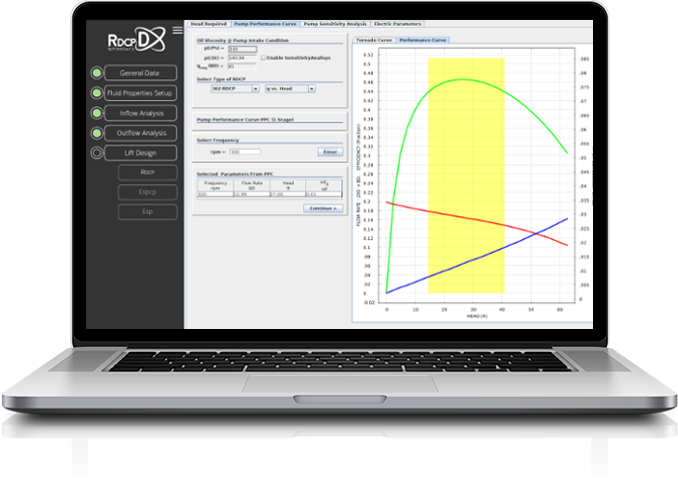
The cylindrical rotary displacement pump RDCP is composed of several stages. Each stage has a stator and a rotor. The rotor is the only moving part inside the pump due to the rotational movement of the shaft, which is connected to the motor. It represents an excellent alternative to produce fluids with high viscosity, from great depths and with high efficiency. The RDCPD is a computational application developed for designing an RDCP system. The app was specially developed to consider the fluid properties, the inflow and outflow analysis. Considering that the RDCP system is very sensitive to viscosity, the fluid properties setup module was specially designed and structured. The design module permits to calculate the pump performance curve for head and power, at different flow rates values. Also, it considers others security factors which together with a viscosity sensitivity analysis can be predict an optimum number of stages, with the corresponding power consumption, efficiency, and certain electrical parameters many times required for clients. A tornado curve is also included in this software. As a result of a simulation, a general report is generated for the software.
Designed By: Eng. Richard Marquez Guillen, Ph.D Co-Designed By: Eng. Jairo Garcia Developer: Rafael Cayama, Jesus Oroño, Zeudy Galban, Robert Quintero
TrajectoryD
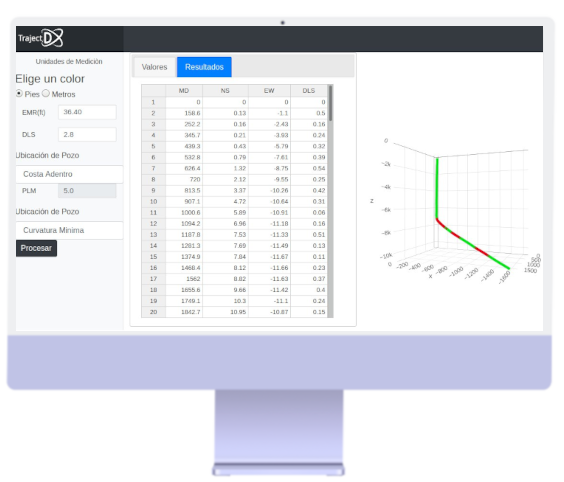
Sometimes, it is necessary to identify straight zones in very inclined wells for the settlement of production systems such as electrical submersible pumps. If well information referred to the azimuth is available, TRAYECTORYD allows the determination of the optimum depth of settlement of the pump based on the maximum degree of deviation allowed (Dog Leg Severity DLS). The results are displayed in a 3D graph, showing the best settlement zones of the artificial lift system.
Designed By: Eng. Richard Marquez Guillen, Ph.D Co-Designed By: Eng. Jairo Garcia Developer: Rafael Cayama, Jesus Oroño, Zeudy Galban, Robert Quintero
BennuValve App
Surface valve simulation and design application for production improvement, design characterization, physical and mathematical foundations.
Designed By: Eng. Richard Marquez Guillen, Ph.D Co-Designed By: Eng. Jairo Garcia Developer: Rafael Cayama, Jesus Oroño, Zeudy Galban, Robert Quintero